Understanding ETF
Technicals and Maths

What is an ETF?
An Exchange-Traded Fund (ETF) is a type of investment fund that trades on stock exchanges, similar to individual stocks. An ETF holds assets such as stocks, bonds, or commodities and aims to replicate the performance of a specific index. ETFs are designed to offer investors a way to pool their money in a fund that makes investments in stocks, bonds, or other assets and, in return, to receive an interest in that investment pool.

How Does an ETF Work?
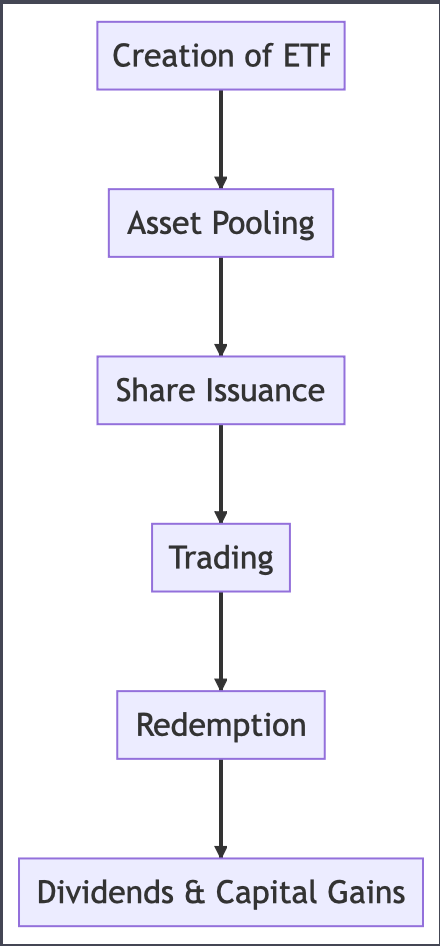
Creation of the ETF: An ETF provider decides on the asset composition of the fund and partners with authorized participants (APs), usually large financial institutions, to create the ETF.
Asset Pooling: The APs acquire the assets that the ETF wants to hold and then transfer those assets to the ETF provider.
Share Issuance: In return for the assets, the ETF provider gives shares of the ETF to the APs, which are then sold on stock exchanges.
Trading: Individual investors can buy and sell these ETF shares on stock exchanges, just like any other publicly traded shares.
Redemption: APs can also redeem ETF shares by giving them back to the ETF and receiving the equivalent value in underlying assets.
Dividends and Capital Gains: Any dividends or interest from the ETF's holdings are paid out to shareholders, usually on a quarterly basis.
Bitcoin ETF as an Example
A Bitcoin ETF aims to offer investors exposure to Bitcoin without actually having to buy, store, or secure the cryptocurrency themselves. The ETF would hold Bitcoin as the underlying asset and track its performance.
Technicals and Math
Price Tracking:
ETF Price=

In a Bitcoin ETF, the Total Value of Assets would be the current market value of the Bitcoin held by the ETF.
Expense Ratio:
Expense Ratio=

This ratio indicates the annual fee that the ETF charges its investors.
Tracking Error:
Tracking Error=

This measures how well the ETF is replicating the performance of Bitcoin.



Risk Management
Diversification: Unlike directly owning Bitcoin, a Bitcoin ETF may be part of a diversified portfolio, reducing risk.
Liquidity: ETFs are generally more liquid than other investment vehicles, making it easier to enter or exit positions.
Regulatory Oversight: Being a financial instrument, ETFs are subject to regulatory oversight, offering a layer of protection to investors.
Counterparty Risk: The involvement of APs introduces counterparty risk, which is the risk that the AP may default on its obligations.
Market Risk: The value of the ETF is tied to the value of Bitcoin, which is highly volatile.
Diagram: Bitcoin ETF Workflow
Let's visualize the workflow of a Bitcoin ETF.